How Peru is putting the spotlight on agrobiodiversity and its custodians
Sustaining the spotlight will require concerted efforts to create monitoring and rewarding systems
Introduction
Three years since the development of the Payamakis Agrobiodiversity Zone in Peru, Rita Parcco, farmer and representative of this zone, tells us how agriculture has slowly shifted from subsistence to commercial, providing a much needed boost to the economy in her village. At the same time, efforts to conserve native potato diversity have expanded. Parcco explains that, through a repatriation process, more than 200 native potato varieties have recently been returned to her community and ABDZ.
Peru has lessons to offer other nations when it comes to protecting agrobiodiversity.
From a strong focus on native potato conservation, how did the country come to legally recognize agrobiodiversity and the knowledge systems that maintain those? After a remarkable process and huge undertaking, the legal figure of Agrobiodiversity Zones (ABDZ) came to life in 2016, and has its origins in social movements that predated the Convention on Biological Diversity.
The Andean and Amazonian communities have collectively woven the social-ecological and cultural fabric of Peru for thousands of years, maintaining exceptional genetic diversity in the region, from crops such as potato, maize, tomato, sweet potato, quinoa, and aji to ancient domesticated animals such as alpaca, llama, vicuna, and cuy.
More than potato conservation
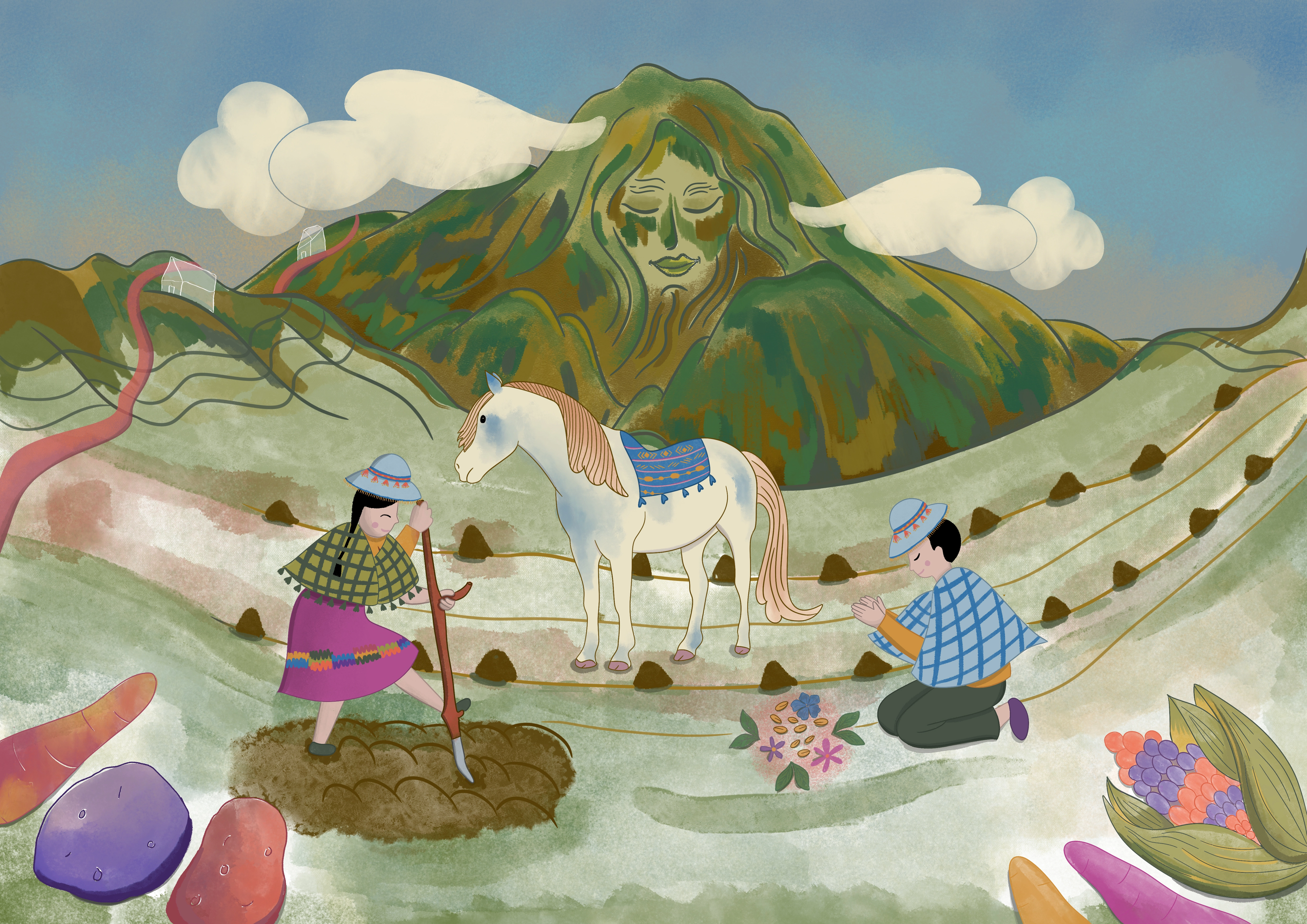
Parcco explains that practices such as ayni and minka remain living systems of governance, reciprocity, and land stewardship. These are not merely traditions, but the foundation on which Peru's Agrobiodiversity Zones were ultimately built.
Yet today, these systems do not operate in isolation. With interconnected global markets and changing economies, farming communities are under intensifying pressure that puts farm diversity and heirloom races at risk, while climate change further threatens food security through droughts, floods and pests.
Within this context of cultural continuity and increasing vulnerability, the recognition of Agrobiodiversity Zones becomes significant. What differentiates the ABDZs from protected areas is that they are lands owned and managed by communities.
The creation of ABDZs not only recognizes the importance of protecting biodiversity but also the mechanisms that have made it possible: local knowledge, culture, access to land, and food sovereignty that allow communities to govern their landscapes to their full ability.
ABDZs and land tenure
Since 2016, the ABDZs have been formally recognized through an official decree, establishing them as a legal figure with criteria that communities must meet to be designated as an ABDZ.
Land tenure has remained one of the main barriers, because many communities did not have regularized property titles. This created an incentive for regularization and formalization of land rights, which became a legal requirement to attain the status of ABDZ.
For some experts, being part of ABDZs is not only about tangible benefits to the communities, but also a legal strategy to counteract extractive activities and promote a broader vision of biocultural heritage.
Why success hinges on rewarding custodians
Recognition alone is not enough, and how farmers see the zones benefiting them is absolutely key. Without functioning governance and incentives, the designation risks becoming symbolic rather than transformative.
Addressing this gap requires stronger institutional backing, such as a stable source of financial inputs. Several contributors argue that a national law for agrobiodiversity conservation, with ABDZs as its cornerstone, would facilitate public funding and provide stability for long-term conservation efforts.
At the same time, communities continue to ask for roads, market access, education, better housing, and practical support that can make these territories more attractive for younger generations.
What can other countries learn from Peru?
The legal recognition of biocultural zones at the national level should inspire other countries. Peru's commitment stands out because the process has national ownership and was built through collaboration among farmers, scientists and policymakers.
Monitoring the success of such projects is equally important for adoption and adaptation. Genetic diversity is alive and dynamic, and monitoring it means understanding not only biological change but also nutrition, culture, wellbeing, and ecosystem functions.
While Peru is the first country to develop Agrobiodiversity Zones and elevate the custodians and knowledge holders of its agrobiodiversity, creating specific rewarding models will be its key test against time.
The objective of the Zones of Agrobiodiversity is to contribute to improving the living conditions of Indigenous peoples by strengthening and consolidating the conservation, sustainable use, and local management of native agrobiodiversity (MINAGRI, 2016).
Story written by Radhika Gupta, in collaboration with Silvia Martinez, Hector Andres Lopez Mariaca, Roseline Remans, Natalia Estrada Carmona, and Sarah Jones. Illustrations © Radhika Gupta.
In memory of Dr. Marleni Ramirez, whose professional contributions played a crucial role in advancing the development of agrobiodiversity zones.
Explore Stories
Jump directly to the other impact stories from here.