Making Agrobiodiversity Data Actionable for Food Systems and Biodiversity Goals
Insights for Agrobiodiversity Practitioners, Scientists and Policy Makers
Key Messages
Agrobiodiversity is a core component of biodiversity that sustains food production, food security, and resilience.
Despite its importance, agrobiodiversity often falls between sectors and decision frameworks.
The Agrobiodiversity Index Food Planet Prize funded a workshop where around 20 agrobiodiversity researchers and practitioners reviewed characteristics and examples of actionable agrobiodiversity indicators.
A small set of science-based node indicators can make agrobiodiversity data more actionable. The following indicators could be used by and connect different actors and scales:
Effective species number in production
Percentage of (semi-)natural habitat in agricultural landscapes
Dietary species richness
Evidence shows that reference points can be defined for these indicators scales.
Agrobiodiversity data become actionable when indicators are interpretable, scalable, and linked to decision levels.
Coordinated collaboration among researchers, practitioners, policymakers, and civil society can reinforce agrobiodiversity data into decision-support and strengthen its role in food systems transformation.
Why Agrobiodiversity Data Matter
What Is Agrobiodiversity?
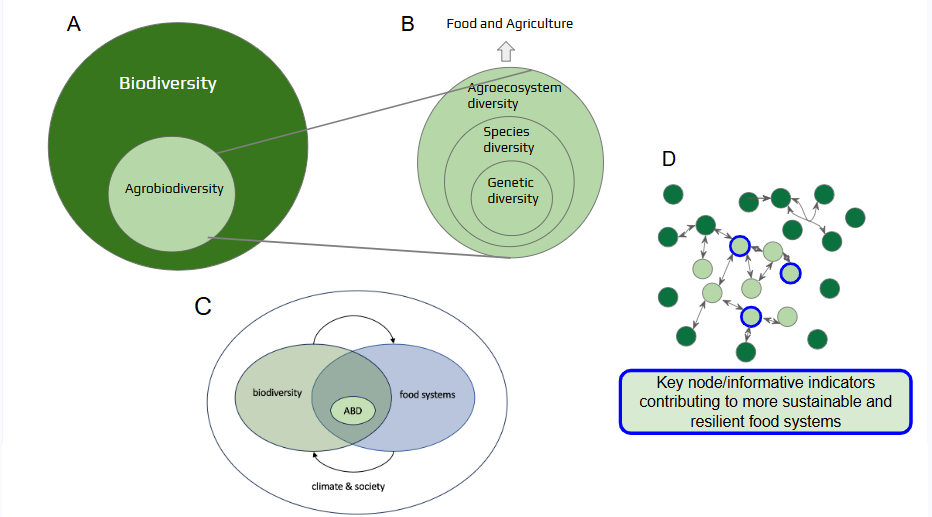
Agrobiodiversity is defined as the variety of animals, plants, and microbes used for food and agriculture (FAO definition, 1999), encompassing genetic resources (crops, livestock), supporting species (pollinators, soil microbes), and the diversity of agroecosystems (farms, fisheries, forests).
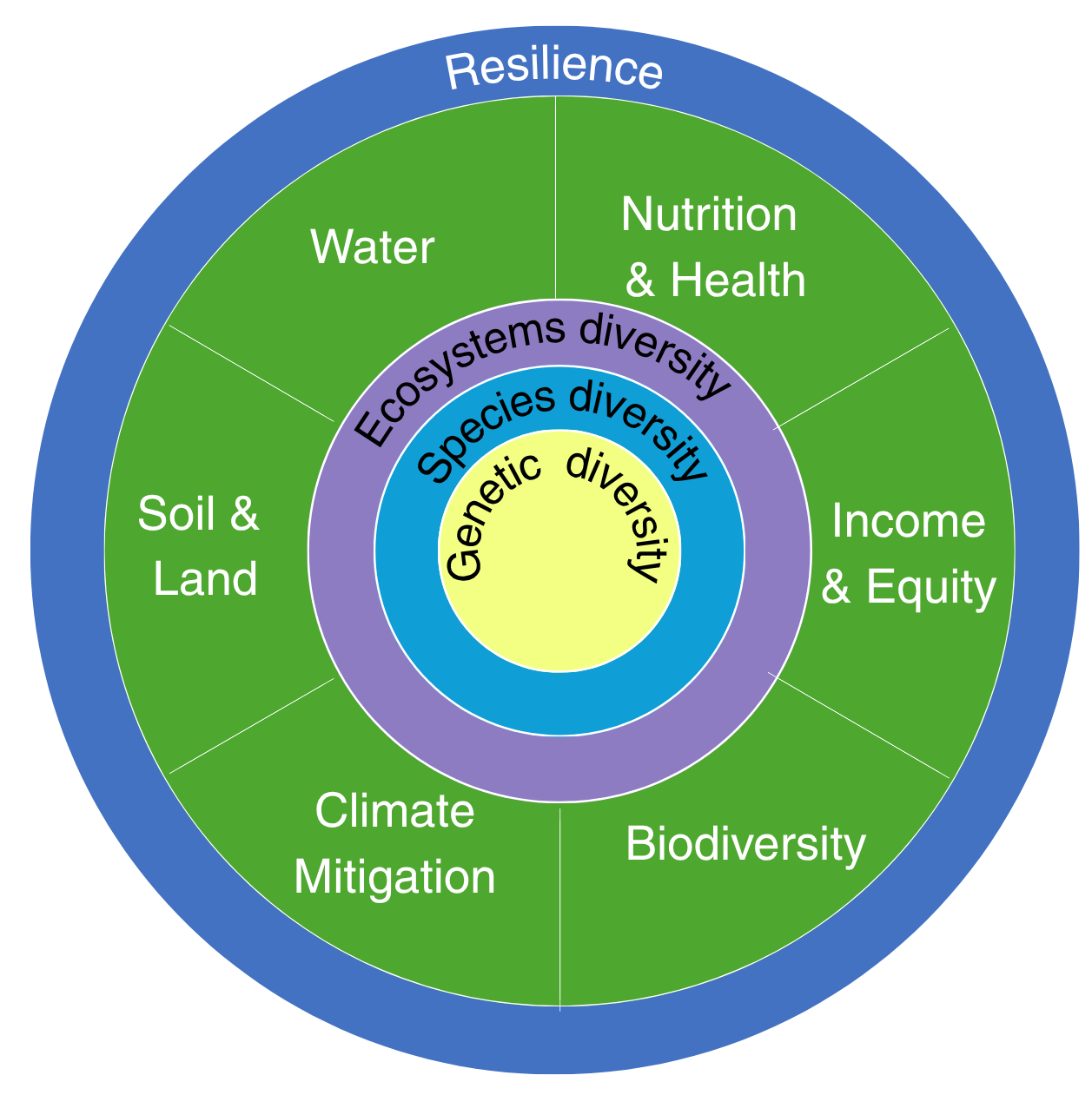
Agrobiodiversity is a core component of biodiversity that sustains food production, food security, and resilience and results from interactions between genetics, environment, human knowledge and management practices. Through these pathways, it contributes to multiple goals, including environmental, economic and social goals.
Why Agrobiodiversity is Difficult To Act On
Agrobiodiversity sits at the nexus of food systems sustainability and biodiversity. Hence, it often falls through the cracks of conservation, production, and food system monitoring and decision-making because it does not fit neatly within wild biodiversity frameworks, is not fully captured by conventional agricultural statistics, and requires nuanced interpretation.
It also spans multiple dimensions, such as genetic, species, and ecosystem diversity, and contributes to multiple goals. That multifunctionality is essential, but it also raises questions about what should be measured, how, and for what purpose.
Focusing on Node Indicators
Monitoring all dimensions of agrobiodiversity is neither feasible nor necessary. Building on the Agrobiodiversity Index framework and its applications, priority is placed on identifying node indicators, measurable signs or signals that sit at critical nodes for food system sustainability and biodiversity. They should be actionable, meaning decision-relevant, interpretable, scalable, and governed through transparent methods.
What and Whose Decisions Can Agrobiodiversity Data Support
Agrobiodiversity indicators can inform decisions at individual, farm, landscape (subnational), national and global level. Indicators that are relevant at different spatial levels further serve to connect decisions and strengthen multi-level collaborations. Examples of decisions that agrobiodiversity data can inform are presented in Table 1.
Table 1. Decisions that agrobiodiversity data can inform at different spatial levels.
| Farm level | Landscape (sub-national) level | National level |
|---|---|---|
|
|
|
Taken together, agrobiodiversity data play a critical role in identifying food systems vulnerabilities and opportunities for effective nexus actions and investments that can contribute to multiple domains of sustainability, from farm to national and global scales. Key users of such data include farmers and advisory services, landscape planners, ministries, procurement actors, and civil society organisations.
Why Action Is Needed Now
While a strong body of evidence demonstrates that agrobiodiversity supports social, economic, and environmental goals at farm, landscape, national, and international levels, limited interpretability and actionability continue to hamper its broader and more systematic use. At the same time, recent developments create a unique opportunity.
Growing recognition of systems and nexus approaches.
Expanded scientific evidence and methodological advances.
New data streams, including remote sensing, market and dietary data, citizen science, and improved statistics.
GBF Target 10, and inclusion of the Agrobiodiversity Index as a complementary indicator.
How to Make Agrobiodiversity Data Actionable
Build On Scientific Advances and Multi-Disciplinary Networks
The Agrobiodiversity Index (ABDI) provides a framework and methodology for monitoring agrobiodiversity across conservation, production, and consumption. Through an array of indicators, it tracks status, commitments, and actions to increase agrobiodiversity's use and conservation, and highlights the risks and opportunities of agrobiodiversity change for people and nature.
Furthermore, strengthening actionability requires collaboration across actors, institutions, sectors, models, and scales. Beyond advancing the scientific substance, it is equally important to invest in building connections, mutual understanding, and collaboration across disciplines and communities of practice.
To advance ways to enhance actionability of agrobiodiversity data, the following components are proposed:
A shortlist of best-bet indicators.
Options for setting reference points across contexts and scales.
Recommendations on data pipelines and communication for decision-making.
Identifying Best-Bet Indicators
Building on an initial scoping of the literature and collaborative discussions among an Agrobiodiversity Food Planet Prize funded workshop held in Montpellier, France, bringing together around 20 agrobiodiversity experts from different backgrounds, a first set of best-bet indicators emerged. These indicators capture agrobiodiversity's contributions to specific sustainability dimensions of food systems and for which scientific literature has identified quantifiable reference points to help users decide how much and what types of agrobiodiversity is enough to secure these contributions.
Table 2. Best-bet indicators to measure agrobiodiversity's impact on different food systems dimensions.
| Indicator | What it captures | Why it matters |
|---|---|---|
| Effective species number in production | An intuitive species count that accounts for both species richness and evenness. | Supports interpretation of yield stability at farm and national scales, and helps assess how resilient production systems remain over time. |
| Dietary species richness | The number of species consumed in diets, complementing conventional diet diversity scores. | Provides a more direct way to connect agrobiodiversity with nutrient adequacy and healthier diets. |
| Proportion of (semi-)natural habitat | A validated proxy for functional integrity in managed landscapes. | Signals whether landscapes can sustain ecological functions such as pollination, soil erosion control, and pest control. |
Cultural biodiversity is recognised as critical for food sovereignty and cultural identity, though further work is needed to determine how best to capture it. Agrobiodiversity is deeply intertwined with cultural diversity and traditional knowledge, each sustaining the other.
While robust metrics for measuring biocultural dimensions of agrobiodiversity remain underdeveloped, legal recognition of sites that preserve it offers a promising pathway. The designation of agrobiodiversity zones, for example in Peru, can provide communities engaged in in-situ conservation with formal protection, legitimacy, and institutional support.
Setting reference points
For agrobiodiversity indicators to be actionable, they must be interpretable relative to reference points. Existing and potential reference points were discussed for the three priority indicators.
Diets: A global reference point already embedded in SDG 2 is a minimum of five food groups per day in women's diets for a healthy diet. This could be complemented by a minimum of ten species per day in diets.
Production stability: A minimum of X effective species number for lowering risk of losing yield by Y%. This reference point is still to be determined.
Landscape functional integrity: A benchmark of >=20-25% (semi-)natural habitat in agricultural landscapes for ecosystem functioning, and no reduction through time if higher.
Prioritising Indicators that Can be used to Integrate Agrobiodiversity into Models
Further integration of agrobiodiversity into modelling frameworks used for national and regional decision-making is strongly recommended. Initial integration of agrobiodiversity indicators has already been achieved in models such as IMPACT and the FABLE Calculator, as well as in farm- and landscape-level models.
One key barrier is the limited comparability of conventional diversity indices through time and across space, and the lack of reference points to facilitate interpretation. In contrast, the priority indicators suggested above are directly interpretable using transparent reference points and are more readily comparable across contexts and through time.
A second challenge relates to data resolution. Spatial crop allocation datasets used in macro-level economic models remain too coarse to characterise changes in agrobiodiversity that influence ecological processes at farm or landscape level.
These advances will enable closer collaboration between agrobiodiversity researchers and economic modeling communities to better leverage agrobiodiversity indicators, data, and interventions in food system scenario analyses.
Next Steps Call to Action
As a group of international agrobiodiversity scientists and practitioners, we call for three actions:
Collaborate to address data and knowledge gaps on agrobiodiversity, bringing together science, practice and policy insights across sectors.
Integrate and mainstream the existing agrobiodiversity indicators, data and insights into decision-making at farm, landscape, and national levels.
Communicate the multifunctional role of agrobiodiversity in food systems and societies, engaging a diverse range of actors.
Join us in advancing these priorities.
Purpose, methodology and context
This insights brief is based on a three-day participatory workshop held in Montpellier (17-19 November 2025), co-organised by the Alliance of BI-CIAT and glocolearning, funded by the Agrobiodiversity Index Food Planet Prize.
Twenty experts and practitioners from the Alliance BI-CIAT, Cirad, CNRS, glocolearning, IRD, and collaborators engaged through visioning exercises, world cafes, indicator ranking, framework refinement, and collaborative synthesis to identify pathways for making agrobiodiversity data more interpretable and actionable across scales.
This work contributes to a broader process aimed at:
- Sharpening the Agrobiodiversity Index (ABDI), including its application for GBF Target 10.
- Strengthening communication and engagement around agrobiodiversity data.
- Building a stronger global community on agrobiodiversity science for people and nature.
The brief focuses on species- and ecosystem-level agrobiodiversity indicators that can be operationalised across production systems, landscapes, and diets. Genetic diversity indicators are critical but were not included in the scope of this workshop.
This brief is part of a larger communication strategy with an upcoming perspective paper, followed by a photo competition and serious game.
This brief has been co-developed by Silvia Martinez, Sarah Jones, Natalia Estrada Carmona, Silvia Araujo De Lima, Silvia Araujo De Lima, Roseline Remans and collaborators.
Explore Stories
Jump directly to the other impact stories from here.